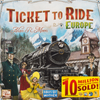


Ticket to Ride: Europe
Build railway routes across a richly illustrated map stretching from Edinburgh to Constantinople and from Lisbon to Moscow. This standalone entry in the acclaimed Ticket to Ride series adds new layers of strategy while preserving the approachable rules that made the original a modern classic.
Players collect coloured train cards in order to claim railway routes connecting major European cities. Longer routes score more points, but require careful planning and the right combination of cards. Each player also receives secret destination tickets that award bonus points if the connected cities are successfully linked by the end of the game. Failing to complete these routes results in penalties, so risk management becomes central to every decision.
Ticket to Ride Europe introduces tunnels, ferries and train stations. Tunnels create uncertainty because additional cards may be required when building through mountainous regions. Ferries require locomotive cards to cross seas and rivers. Train stations allow players to use an opponent’s route once, offering a safety net for blocked connections while costing valuable points.
The game flows in steady turns where players either draw train cards, claim routes or pick up additional destination tickets. Interaction is indirect but meaningful as players compete for limited route space across the map. Timing and route efficiency often determine the winner.
Designed for two to five players and lasting around sixty minutes, Ticket to Ride Europe balances accessibility with strategic depth. When the final trains are placed and longest route bonuses awarded, victory belongs to the player who planned their continental network most effectively.
Ticket to Ride: Europe
Build railway routes across a richly illustrated map stretching from Edinburgh to Constantinople and from Lisbon to Moscow. This standalone entry in the acclaimed Ticket to Ride series adds new layers of strategy while preserving the approachable rules that made the original a modern classic.
Players collect coloured train cards in order to claim railway routes connecting major European cities. Longer routes score more points, but require careful planning and the right combination of cards. Each player also receives secret destination tickets that award bonus points if the connected cities are successfully linked by the end of the game. Failing to complete these routes results in penalties, so risk management becomes central to every decision.
Ticket to Ride Europe introduces tunnels, ferries and train stations. Tunnels create uncertainty because additional cards may be required when building through mountainous regions. Ferries require locomotive cards to cross seas and rivers. Train stations allow players to use an opponent’s route once, offering a safety net for blocked connections while costing valuable points.
The game flows in steady turns where players either draw train cards, claim routes or pick up additional destination tickets. Interaction is indirect but meaningful as players compete for limited route space across the map. Timing and route efficiency often determine the winner.
Designed for two to five players and lasting around sixty minutes, Ticket to Ride Europe balances accessibility with strategic depth. When the final trains are placed and longest route bonuses awarded, victory belongs to the player who planned their continental network most effectively.