
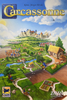


Carcassonne invites players to build the medieval landscape of southern France one tile at a time. Roads wind through open fields, cities rise behind sturdy walls and monasteries appear in quiet clearings as the countryside gradually takes shape. With simple rules and deep tactical choices, Carcassonne remains one of the most enduring and accessible strategy games ever published.
On your turn you draw a single landscape tile and place it adjacent to tiles already on the table, ensuring that roads connect to roads, cities to cities and fields to fields. After placing a tile you may deploy one of your limited meeples to claim a road, city, monastery or field. These claims determine how you score points as features are completed. Roads score when they connect from end to end. Cities reward more points but require careful expansion. Monasteries score based on surrounding tiles. Fields score at the end of the game for completed cities they border.
The tension lies in timing and positioning. Meeples committed to unfinished features cannot be used elsewhere until that feature is completed, so every placement decision carries opportunity cost. Players must weigh immediate scoring against long-term positioning while also reacting to opponents who may extend or disrupt shared features.
Carcassonne supports two to five players and typically plays in around thirty to forty-five minutes. The rules can be taught in minutes, yet the spatial strategy and subtle player interaction create lasting replay value. When the final tile is placed and farms are scored, victory goes to the player who shaped the landscape most efficiently and claimed the richest territories.
Carcassonne invites players to build the medieval landscape of southern France one tile at a time. Roads wind through open fields, cities rise behind sturdy walls and monasteries appear in quiet clearings as the countryside gradually takes shape. With simple rules and deep tactical choices, Carcassonne remains one of the most enduring and accessible strategy games ever published.
On your turn you draw a single landscape tile and place it adjacent to tiles already on the table, ensuring that roads connect to roads, cities to cities and fields to fields. After placing a tile you may deploy one of your limited meeples to claim a road, city, monastery or field. These claims determine how you score points as features are completed. Roads score when they connect from end to end. Cities reward more points but require careful expansion. Monasteries score based on surrounding tiles. Fields score at the end of the game for completed cities they border.
The tension lies in timing and positioning. Meeples committed to unfinished features cannot be used elsewhere until that feature is completed, so every placement decision carries opportunity cost. Players must weigh immediate scoring against long-term positioning while also reacting to opponents who may extend or disrupt shared features.
Carcassonne supports two to five players and typically plays in around thirty to forty-five minutes. The rules can be taught in minutes, yet the spatial strategy and subtle player interaction create lasting replay value. When the final tile is placed and farms are scored, victory goes to the player who shaped the landscape most efficiently and claimed the richest territories.